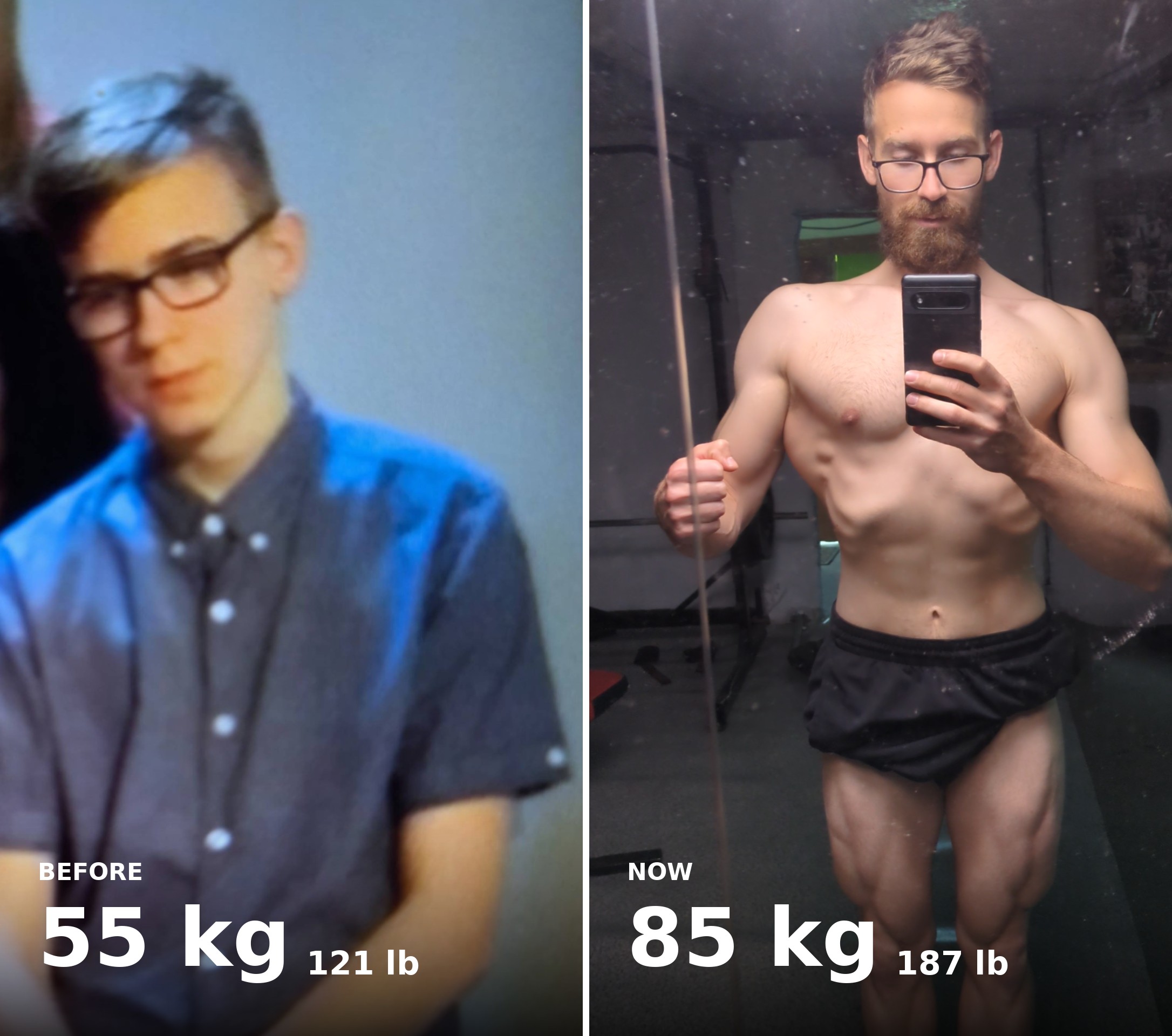
A few years ago I weighed 55 kg (about 120 lb). I was very, very skinny, and I wanted the opposite: big legs, wide shoulders, that X-shaped physique. Since then I’ve put on around 30 kg (66 lb). Not all of it is muscle, obviously, but a lot of it is.
This isn’t a program. It’s what kept me going for years, and it all comes down to one idea: treat the gym like brushing your teeth.
Adherence beats everything The most important thing is adherence. You can have a big vision of training 6 or 7 days a week, but if you don’t enjoy it, you’ll quit. Or you’ll build a picture in your head where everything is perfect, and the first time life gets messy, that picture breaks. And life gets messy. Sometimes it’s work, sometimes it’s stress. For me it was jaw treatment and braces. When they expanded my jaw I was in a lot of pain, I couldn’t eat what I wanted, and my sleep wasn’t great either. A perfect plan wouldn’t have survived that.
You don’t need 100% every day What kept me training through all of that was knowing you don’t have to use 100% of your capacity every time. Some days you do the minimum. Some days you land in the middle. And some days you feel amazing, like summer in California, and you do 20 sets and actually grow. On the minimum days you might gain almost nothing, but you’re still building the habit, and the habit is what compounds. During COVID I trained at home every other day for almost two years. Push-ups, rows, pull-ups, bands, small dumbbells, a ton of lunges, glute bridges, single-leg RDLs. Lots of reps, nothing fancy. And I had fun every single time. That’s the part most people skip.
Just enough stress The more something runs on autopilot, the less motivation it needs. Most people don’t need a pep talk to go to a party. Introverts are the exception: for them a party can take more willpower than the gym, a book, or even making money. What feels effortless depends on what you’ve wired yourself to enjoy. People who stick with the gym for years, me included, like how it feels, and they know how much stress they can actually handle. Take every set to failure with tons of volume, intensity, and frequency, and you’ll suffer. Your sleep gets worse, you feel anxious, and your brain starts filing the gym under “pain.” Once that association sets in, you’re done.
A bulk you can live with The third mistake is the miserable bulk. You can’t stick with this if you spend half your day in the kitchen and feel bloated and heavy all the time. The real question isn’t how fast you can gain. It’s how long you can bulk without feeling like you’re bulking. Gain aggressively for 3 months and you’ll feel like shit. Round face, tired all the time, sick of food. Maybe that’s the most optimal way on paper, but I don’t think it’s a good way. A slower approach that isn’t 100% optimized lets you bulk for 8 or 10 months, cut for 2, and actually enjoy your life in between. Ten years from now you’ll be healthier, stronger, and still training. That’s the real optimal.
Keep the workout simple The same goes for the workout itself. I really love supersets, though you need a private gym or good equipment you don’t have to fight over. Pull-ups with dips, squats with leg curls, deadlifts with leg extensions. Somebody will say it’s not optimal. Fine. It’s fast, it’s fun, and I keep showing up for it.
Train like you brush your teeth You brush your teeth every day without thinking about it. You know that if you skip it, you’ll have problems. Add flossing and you’ve covered almost 99% of your oral hygiene. Once in a while you go to the dentist for a deep clean or some specific work, but that’s the exception, not the routine. The gym works the same way. Show up, do the basics, keep the effort at a level you can repeat for years. Go big on the days you feel great and don’t stress the small ones. The fundamentals do the heavy lifting.
Message board · 0 approved comments
No approved comments yet. A suspiciously peaceful corner of the internet.
Leave a comment
Plain text only. New messages wait for moderation before appearing.